









Corporate Sustainability Reporting Directive
Sustainable decisiveness: From green promises to true transparency with CSRD
The CSRD marks a new era for companies and organisations, positioning sustainability reporting alongside financial reporting as a core pillar of corporate reporting. Increasingly, organisations are expected to report not only on their financial performance, but also on their environmental, social and governance impacts in a consistent, transparent and comparable way. Sustainability reporting is becoming an integral part of how companies communicate value, risks and long-term resilience.
While the directive has prompted many organisations to assess new requirements and reporting obligations, the regulatory landscape continues to evolve. In February 2025, the European Commission introduced the EU 'Omnibus Simplification Package', proposing measures to reduce complexity and administrative burden. Although these changes affect aspects of the CSRD's scope, timelines and reporting requirements, the direction of travel remains clear: transparent and reliable sustainability reporting is becoming an increasingly important part of doing business in Europe.

Key points of the CSRD
- The CSRD covers sustainability in a broad sense and includes disclosure requirements for a wide range of Environmental, Social and Governance (ESG) aspects.
- For large listed companies, the CSRD took effect as of fiscal year 2024.
- The CSRD requires companies to collect, process and publish a significant amount of data and information; this will require new systems, processes and a governance structure to be put in place.
- The CSRD requires an external auditor to provide limited assurance on sustainability reporting.
The CSRD at a glance: who, when, what and how?
The CSRD forms part of the EU's sustainability and competitiveness agenda. Building on the European Green Deal and Sustainable Finance framework, it aims to improve transparency on sustainability matters while supporting investment, innovation, and long-term economic resilience. Recent Omnibus packages seek to simplify reporting requirements and enhance the competitiveness of European businesses while maintaining the EU's 2050 climate-neutrality objective.

- Who does the CSRD apply to?
- When will the CSRD take effect?
- What to report?
- How to report?
Who does the CSRD apply to?
The outgoing NFRD (Non-Financial Reporting Directive) applied only to listed companies. These companies remain in scope as "Wave 1" undertakings. Likewise, CSRD will apply FY27 onwards to all major EU companies that meet both of the following criteria:
- turnover exceeding €450 million per year
- more than 1000 employees (averaged over a year)
The CSRD will also apply to non-EU companies with a net turnover above €450 million for the parent undertaking within the EU, and above €200 million generated turnover for the subsidiary or branch. For these organization, reporting will be mandatory from FY28 onwards.
A special reporting standard, the ESRS-40a (Formerly called NESRS) will be developed for non-EU undertakings.
When will the CSRD take effect?
It will be phased in for different categories of companies. The obligation to report according to the new Omnibus will apply to:
- Wave 1: Large public interest entities (PIEs) with more than 1,000 employees and €450M turnover — as of fiscal year 2024
- Wave 2: Large companies with more than 1,000 employees and €450M turnover — as of fiscal year 2027
- Wave 3: Listed SMEs are no longer required to report under the CSRD
- Wave 4: Non-EU companies with a net turnover above €450 million for the parent undertaking within the EU, and above €200 million generated turnover for the subsidiary or branch — as of fiscal year 2028
What to report?
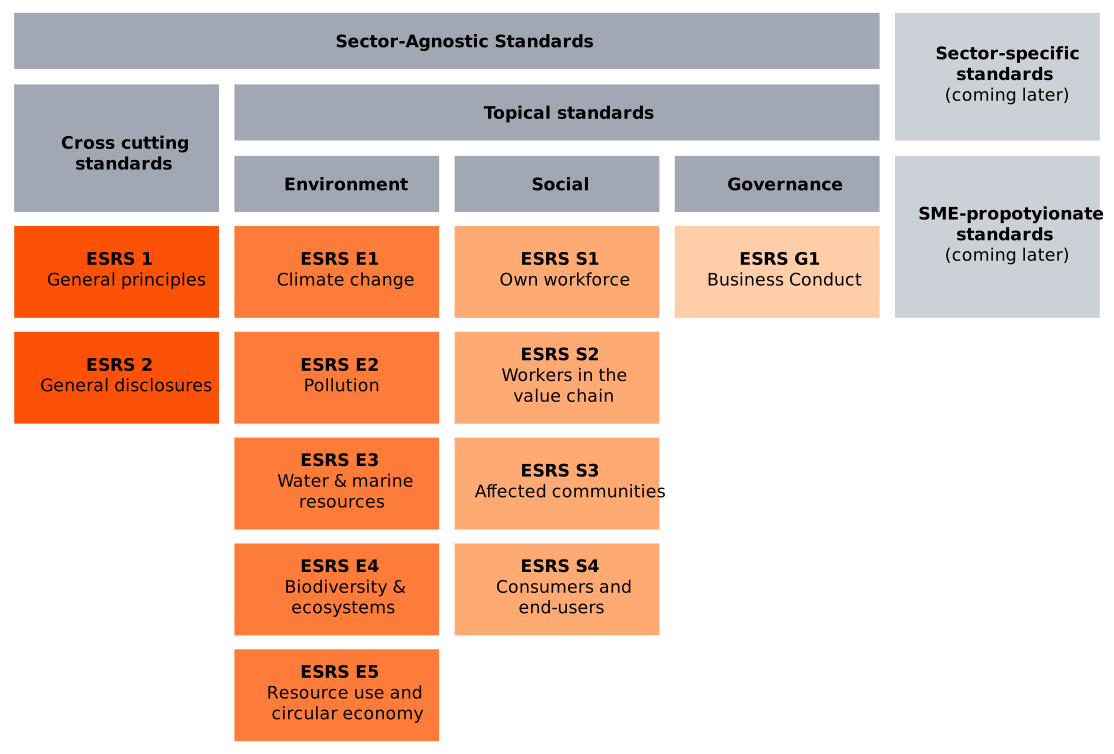
The CSRD requires companies to prepare a sustainability statement based on the European Sustainability Reporting Standards (ESRS), describing their main sustainability-related impacts, risks and opportunities, the sustainability strategy they have formulated, what targets are associated with it, what the policies, action plans and resources are allocated to achieve those targets, and how progress is monitored and reported.
The sustainability report will become a mandatory and integral part of the management report, and it must comply with a set of new reporting standards (ESRS).
How to report?
Companies must make the information available in a prescribed structure, tagged, in electronic format (XBRL) and accompanied by an assurance statement by an external auditor. These requirements are intended to increase the quality, reliability, transparency and comparability of ESG information and bring it to the same level as financial information.
Read more on the ESG Omnibus





CSRD & Strategy
Business leaders are facing a complex landscape - shifting regulations, evolving tax and tariff policies, rising energy costs, and climate-impacted supply chains. We help you embed sustainability into your business strategy to tackle these challenges confidently, unlocking value creation opportunities and building resilience for long-term success.
Read more: Business-led strategies for sustainability
Read more: The sustainability factor: Mastering new drivers of value creation

Thought leadership
The landscape of sustainability and regulation is constantly evolving. This leads to unrest, which we understand. We are always up-to-date with the latest developments within the CSRD, know all the details of the EU Omnibus, are leaders in technical implementation, and conduct market research.
- Sustainability under pressure: how polarisation is reshaping the agenda
- Embrace ESG Omnibus as a strategic opportunity for sustainable growth
- CSRD global survey 2025 - from insight to value
- What the first CSRD statements tell us: better integration of sustainability offers strategic oportunities
- CSRD Global Survey - the promise and reality of CSRD reporting
- CSRD Lookbook - illustrative sustainability statement: structure & content
- CSRD - Double materiality assessment
- CSRD creates new era in sustainability reporting

Streamline your CSRD reporting with PwC's AI-Powered Toolkit
CSRD requirements are comprehensive, complex, and ever-evolving - making it easy to lose sight of the bigger picture. PwC's suite of AI-driven tools helps you cut through the complexity, from automated document analysis and peer benchmarking to AI-powered web scraping, impact scoring, and value chain assessments.
By bringing together powerful analytics, automated drafting, and structured documentation, our toolkit transforms CSRD compliance into a streamlined, insight-driven process - so you can focus on what matters most: driving sustainable value.
Check out our Tech suite
The ultimate power of the ecosystem
Where human ingenuity and technology come together, new perspectives emerge. PwC's sustainable ecosystem brings together strong tech alliances with Oracle, SAP, Icertis, Microsoft and Workday, a joint business relation with system changer Metabolic, and a knowledge partnership with Stichting Deltaplan Biodiversiteitsherstel. From strategy through to execution.
Check out all tech alliancesMaking sure your actions count too.
Ready for sustainable results? Interested to discuss the CSRD impact on your organization?