










Financial figures based on the highest possible profit margins. This is what organisations usually report on. But the tide is turning. After all, results are about more than just black or red figures. Stakeholders are increasingly interested in the social added value of a business, in other words in ‘green figures’.
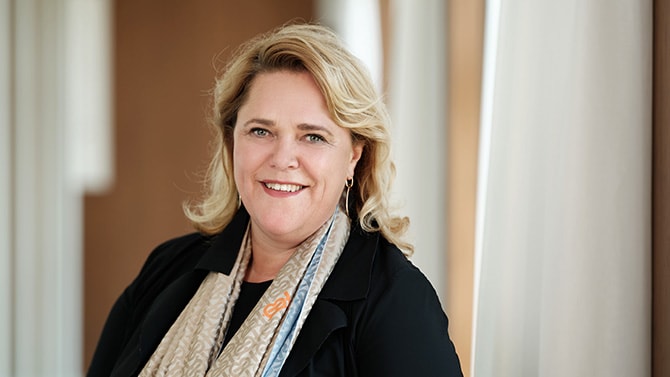
Renate de Lange, member of the PwC Board of Management, talks to Karen Maas, Endowed Professor of Accounting and Sustainability, and Michel Scholte, co-founder of the Impact Institute, about the urgency of green figures.

Karen Maas
It sounds nice: green figures. But what exactly do we mean by it?
De Lange: ‘What's important is the social value that organisations bring. The non-financial figures. Think of the impact on the environment, on people and on society. We call that green figures.’
Maas: ‘I would say: all non-financial subjects that are related to creating social impact. Which topics these are, varies from one organisation to another.’
Scholte: ‘My idea of green figures is that every company should have social annual accounts. It is, of course, a disgrace that the impact that businesses have on people, the environment and society is not visible at all in the figures. Listed companies are required to report on black and red figures. But green figures are hardly required.’
‘I find it really incredible that businesses today still say they don't have a grip on their impact on the world’.
It is a complex challenge, according to many organisations. How can you quantify that impact?
Scholte: ‘It doesn't have to be complex. That is a misunderstanding. There are already examples of businesses that have shown that it is quite possible to produce social annual accounts. ABN Amro for example. The bank used the Impact Weighted Accounts Framework developed with Harvard Business School and Impact Economy Foundation. This allows businesses to calculate social profit and loss. Moreover, a lot of data are easily accessible when it comes to recording the impact in figures. A great deal of information can be retrieved from invoices from energy or other suppliers, for example.’
Maas: ‘I agree entirely. It is often very easy to retrieve the right information. At present everything is recorded and can be accessed digitally. The response of businesses that it is “difficult, difficult, difficult” is therefore really outdated. I find it really incredible that businesses today still say they have don't have a grip on their impact on the world. And that they therefore buy components or raw materials from parties who, for example, violate human rights. That really is no longer responsible.’
De Lange: ‘Maybe it is true that it is not that complex. A great deal of data is indeed available. Yet, in practice, we find that it is not always that simple. In the CEO Survey we conducted earlier this year, many CEOs also indicated that there is still insufficient knowledge available in many organisations to properly grasp this impact.’
How important is it to record those green figures in euros?
Maas: ‘I don't find that very useful. Monetisation is difficult. You translate impact into money, but you are talking about social benefits. Nobody pays anything and nobody gets any money. That does not work. It’s not about real money. This only degenerates into the discussion of why a business should put private money into something that benefits society. Shareholders will inevitably start protesting.’
Scholte: ‘No, I don’t agree. It is about expressing information in a unit. This can also be a financial unit. And that can be very useful. For example, to compare social costs, but also to attach fines to them.
‘Make your impact specific and transparent. Only then can you report properly and your narrative will have depth and conviction.’
What does it cost when a business violates people’s rights? What should a company pay to repair that? Germany, for example, is introducing a new law on national supply chains. It makes it possible to fine businesses that trade with suppliers who violate human rights or environmental rules. In such a case, it works very well to monetise the impact.’
De Lange: ‘Nevertheless, I think that monetising social impact across the board is still a step too far. And I agree with Karen that in many cases it is also complicated. For example, in 2017 we introduced an internal CO2 price of €100 per tonne of CO2. We then use that budget to further reduce carbon emissions. For CO2 there is a market price, but for many impact factors this is not the case at all.’
How do we prevent ‘impact washing’? After all, many organisations feel they have to do something, but the danger is that they take action mainly for show.
De Lange: ‘That’s really changed in the past few years. I see that social impact has become genuinely important. Many organisations are stating the ambition and putting their money where their mouth is. And it is when you make it very specific that you really seem to be able to capture the real impact. Don't be afraid to be vulnerable and be honest when the going gets tough. Then it's real. Therefore, make your impact specific and transparent. Only then can you report properly and your narrative will have depth and conviction.’
Maas: ‘Dare to take a stand and make real choices. I think that many businesses do not dare to set out their ambitions firmly enough. It is often too non-committal. Take responsibility and act accordingly. The government recently decided not to use totally electric official vehicles until 2028, because comfort still leaves something to be desired. Then my reaction is: come off it, one of the ambitions of the government is an energy transition. I find that unbelievable.’
Scholte: ‘I agree entirely. Businesses are often selectively ambitious.’
Renate de Lange
So what can motivate organisations to really start reporting their social impact?
Scholte: ‘Businesses underestimate how much legislation in the field of sustainable business will affect them in the near future. It’s time for managers to see their businesses first and foremost as a tool for creating social value. Not to sell products or make a profit. That only comes second or third. Impact first.’
Maas: ‘And don't forget the social sentiment. It’s boiling over on all sides. All stakeholders demand that businesses take their social responsibility.’
De Lange: ‘See it as an opportunity to keep organisations relevant. The world is changing and stakeholders are becoming more demanding. But that also means adapting business strategy and processes, and collecting different data for reporting.’
What are the pitfalls for organisations in getting involved with green figures?
Maas: ‘That it's just talked about. Make choices, get going and build it up. And don't be afraid to fail either. I do hear entrepreneurs and CEOs say: “I don't want to promise too much, because later I won't be able to fulfil those ambitions.” So what? If a company fails to meet its normal annual targets and ends up in the red, we don't make a big deal out of it either. You will not lose your head if you do not achieve your goals. So long as you show that you are doing your best and that you mean business.’
De Lange: ‘A pitfall is that organisations do too little and dare too little. Paul Polman of Unilever wrote in one of his books: “If, as a manager, the targets you set do not give you a headache, they are not ambitious enough”. And that's completely true.’
Scholte: ‘The pitfall is that green figures become washing powder for greenwashing. Businesses can use them to fake impact. You can already see this happening on a large scale. Superficial claims are made with so-called impactful projects, which in reality bear no relation to what should be done.’
And what are the opportunities?
Scholte: ‘Put impact first and focus your business fully on it. Then you will really become a meaningful business. So, a radical break with the current course. Not less fossil fuel, but no fossil fuel. So, all gas and oil fields in the North Sea must be sealed with cement and replaced by geothermal energy. Reduce the entire livestock industry to zero in the next five years and generate vegetable alternatives in the North Sea. It is an opportunity for the Netherlands to become world leader.’
Maas: ‘We have the wind in our sails in this respect, because young people all want to work for businesses that matter. This generates a new momentum.’
De Lange: ‘It invites organisations to innovate and be inventive. This requires new connections with parties other than you were used to. It is an opportunity that will not only determine the success of organisations to a large extent, but also of our country.’

Michel Scholte
‘It’s time for managers to see their businesses first and foremost as a tool for creating social value’.
Contact us


Follow us


