









To stay on the path to net zero, it is important to measure energy transition progress credibly, consistently and comprehensively. Traditional project evaluation focuses mainly on meeting deadlines and financial results, but for the energy transition this is not enough: the impact of gigantic projects that are supposed to give the energy transition a big push is simply too large for that.
Definition of progress depends on perspective
If you were to ask different parties what progress means, you would most likely get divergent answers. Engineers will consider the ability to scale up new technology, banks emphasise the viability of the business. Governments will look at needed subsidies and permits while voters are more interested in potential jobs and the impact of projects on energy accessibility and energy bills.
A broad framework for measuring energy transition progress
PwC Netherlands is a member of the World Energy Council (WEC), a global network in which companies, (semi) governments and scientists exchange knowledge about a sustainable energy future. Last year, the Dutch members of the WEC took the initiative to explore how that complete, consistent and credible way could be achieved.
From this, the outline of a framework has emerged based on the experiences of a broad group of stakeholders from four major energy transition projects in Rotterdam: Porthos (underground CO2 storage), Hollandse Kust Zuid (offshore wind farm), Holland Hydrogen I (green hydrogen) and WarmtelinQ (heat networks). These are projects with great national impact and international appeal.The report ‘Showing all elements of the energy transition’, in which PwC was closely involved, was presented July 6 in Rotterdam at a meeting of the WEC.
A hotbed of energy transition
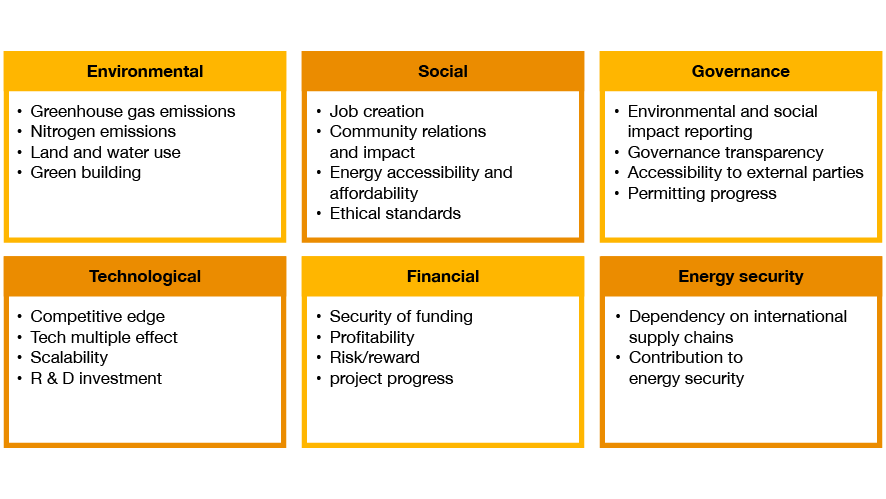
Based on the interviews with these stakeholders, we made a preliminary proposal for a straightforward measurement framework, consisting of different categories within six pillars with performance indicators. This approach is practical because it comes directly from the practice of major Rotterdam projects. Rotterdam is densely populated, home to Europe's largest port, which makes it a highly energy-intensive industrial complex. It is a ‘hotbed’ of energy transition projects in which various interests must be united. It is no coincidence that the next WEC conference will be held in Rotterdam next year.
A broad framework for measuring energy transition progress
Non-traditional indicators are already being included
Several interviews revealed that the four projects are already currently monitoring non-traditional indicators. For example, in Holland Hydrogen, in addition to the cost-effective production of green hydrogen and the realisation of CO2 emission reductions, factors such as circularity, job creation and the local ecosystem are also being considered. In the beginning, the emphasis was mainly on the traditional technical and financial aspects, but over time it turned out that other aspects became equally important in the project story.
Support is a success factor in energy transition
The main challenge of energy transition lies in the technological field as well as in the social and administrative field. If the parties involved and interests are not aligned, projects fail or are delayed. One of 'our' projects - the Porthos project for underground CO2 storage - has already experienced this firsthand when it came to a standstill after a lawsuit over nitrogen emissions. Coordination between all parties is crucial. This applies to projects on a large and small scale: few people are against reducing climate change, but no one wants a wind turbine in their backyard.
Measurement provides direction for adjustment and new solutions
Measuring crucial indicators helps build support and progress. It shows where things are going well and where the bottlenecks are. It gives direction for adjustment and new solutions. Note: the energy transition is, in a sense, one of the greatest experiments ever. No one has done it before. Let's take a very close look at how this goes and how this works. We want to present our framework at the WEC conference next year in Rotterdam so that we can also learn from each other in the international area.
Visit our Sustainability Journey Hub for fresh and relevant sustainability insight

Contact us


Follow us


