









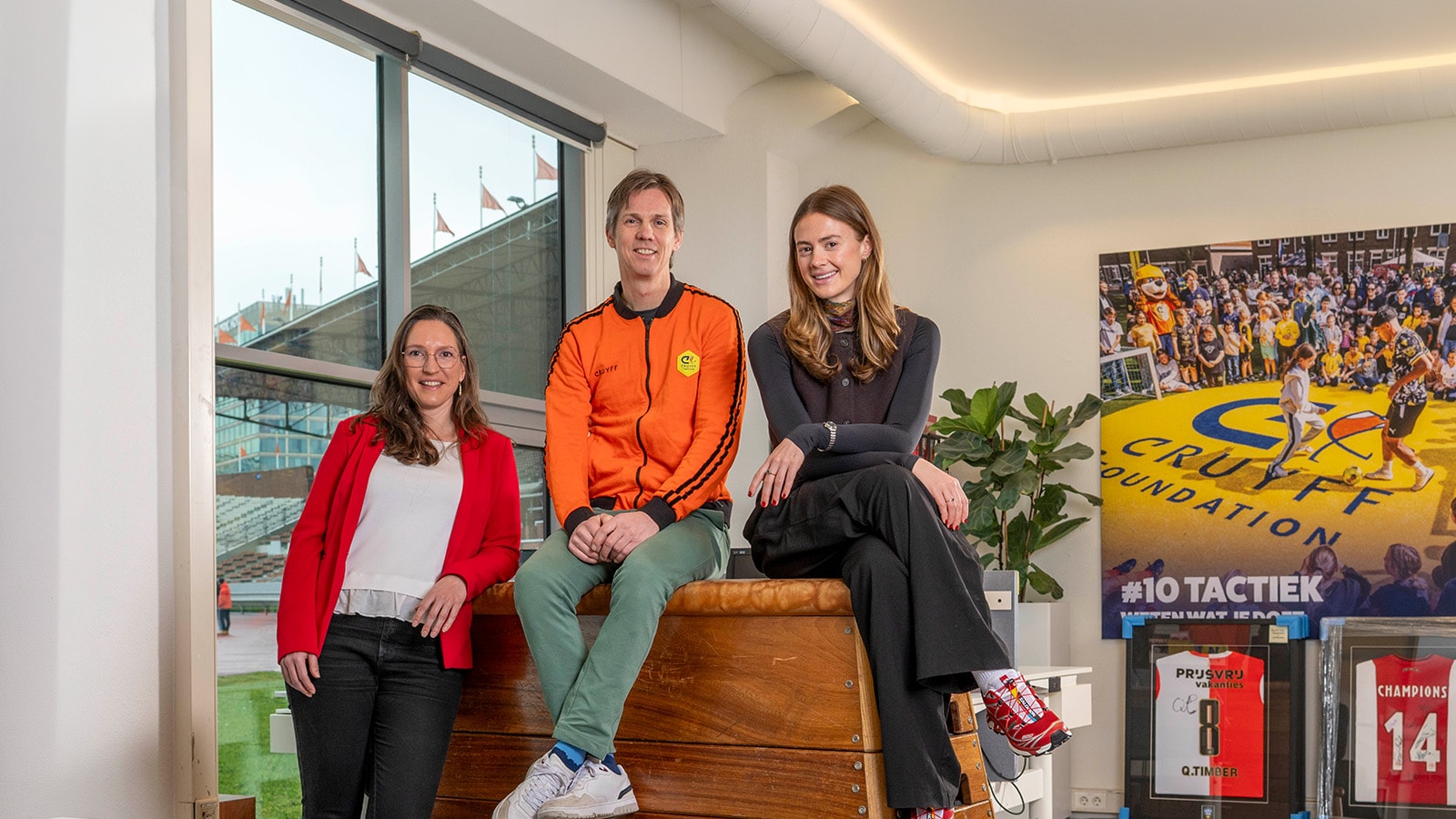
Sport helps girls discover their talents and build confidence. The Johan Cruyff Foundation is actively committed to this mission. Together with PwC, the Foundation is developing an online inclusion training for coaches, offering practical tools to support more inclusive coaching. This can help increase girls’ participation on the Cruyff Courts and contribute to equal opportunities.
PwC has partnered with the Johan Cruyff Foundation for over 20 years. The Foundation’s global mission, Creating Space for Children, closely aligns with our purpose of building trust in society and helping solve important problems.
Currently, only 24% of users of the 200 Cruyff Courts in the Netherlands are girls. The JCF therefore aims to achieve equal participation by 2030, with as many girls as boys active on the Courts (50/50). This would be a concrete step towards gender equality in sport.
Applying knowledge and expertise
‘Diversity, equity and inclusion of women is an important topic for PwC,’ says Judith de Haan, Public Sector manager at PwC. ‘The JCF’s idea to encourage more girls to be active immediately resonated with us. In this project, we support the Foundation with knowledge and expertise – through research, and by helping develop an online training module for Cruyff Court coaches. We also bring insights from other inclusion projects.’
In the first phase of the programme, PwC conducted research into the experiences of girls and coaches with sports activities on the Cruyff Courts, as well as the factors that encourage or hinder girls’ participation. This provides a clear understanding of both the opportunities and the challenges.
Cruyff Courts as a catalyst
Alongside equal access, the focus is on tackling wider societal challenges such as physical inactivity. Particularly in neighbourhoods where opportunities are unevenly distributed, a space like a Cruyff Court can make the difference between girls staying on the sidelines and truly participating.
Ivo Tiemessen, Team Lead for Sportive Outdoor Spaces at the Johan Cruyff Foundation, explains, ‘Cruyff Courts act as catalysts in the priority neighbourhoods where they’re located because they bring opportunities for sport and play closer to home. Physical distance or the cost of sports club membership can often be barriers for young people. The Courts are located right on their doorstep, lowering the threshold to participate. However, girls often need extra support – we need to break the mindset that outdoor play is mainly for boys.’
Safety concerns
PwC Public Sector consultant Noah Leenders adds, ‘More than half of the girls enjoy football, but it can be intimidating if there are lots of boys already on the field. Some girls prefer to join only after they’ve had a chance to practice and feel more confident.’
The baseline measurement also shows that 62% of girls would like to be more active on the Cruyff Courts. Several barriers remain, however. Half of the girls surveyed feel hesitant due to the large number of boys present. Some are afraid of being seen as ‘uncool’, while others feel shy. Parents can also form a barrier, due to their concerns around safety.
Girls require a different approach
Coaches play a key role in creating a sense of social safety. ‘It’s important for coaches to realise that girls require a different approach from boys,’ explains Tiemessen. ‘When boys are given a ball, they will often just start playing; girls tend to explore together first. Social connection and mutual trust matter more to them, and that requires a different coaching style.’
That is why activities at the Courts go beyond sport. They encourage children to organise their own events – from fashion shows to cooking workshops. This helps attract more girls, who then also start using the Courts in their own time. The goal is to lower the threshold for participation.

Activating the whole community
‘We’re developing the online training module to give coaches practical tools to better engage girls,’ explains Tiemessen. ‘Coaches are crucial – they can activate an entire neighbourhood.’
De Haan adds, ‘The coaches we interviewed appreciated being involved from the outset. They emphasised the importance of including girls from the very beginning to understand what matters to them, and that’s exactly what we’re doing.’
Practical tools through the training module
One of these coaches is Suzanna Deckers, sports facilitator for the municipality of Hoorn. She says, ‘When you get girls outside you see them gain confidence in their environment. Out on the Courts they discover their talents and realise they can do more than they thought. Their self-confidence grows and they become mentally stronger – you literally see them flourish.’
Deckers’ team works with a group of 52 girls through sport, as well as creative activities such as nail art and drawing workshops.
‘Many girls still find it intimidating to come alone. A personal approach works better than a flyer. The online training module currently in development will provide practical tools to involve girls even more effectively. It will also be valuable for new coaches.’
Looking ahead
The online training module will be tested with coaches before the summer and rolled out in the autumn. Annual impact measurements will then assess whether participation increases among girls. Together with PwC, the Johan Cruyff Foundation is fully committed to achieving this goal. Additional initiatives include Heroes of the Cruyff Court – Girls’ Edition, as well as events for local girls and a national Girls’ Day. They are all part of the inclusion programme supported by PwC.
This project is about more than sport alone. It is about helping girls feel that the world outside belongs to them too – neighbourhood sports fields are for everyone, not just boys. Reaching the 50/50 goal by 2030 would be more than a statistic; it would stand as the ultimate achievement for everyone who believes equal play begins with equal opportunity.
Do you want to learn more about the Johan Cruyff partnership?
Contact us


