









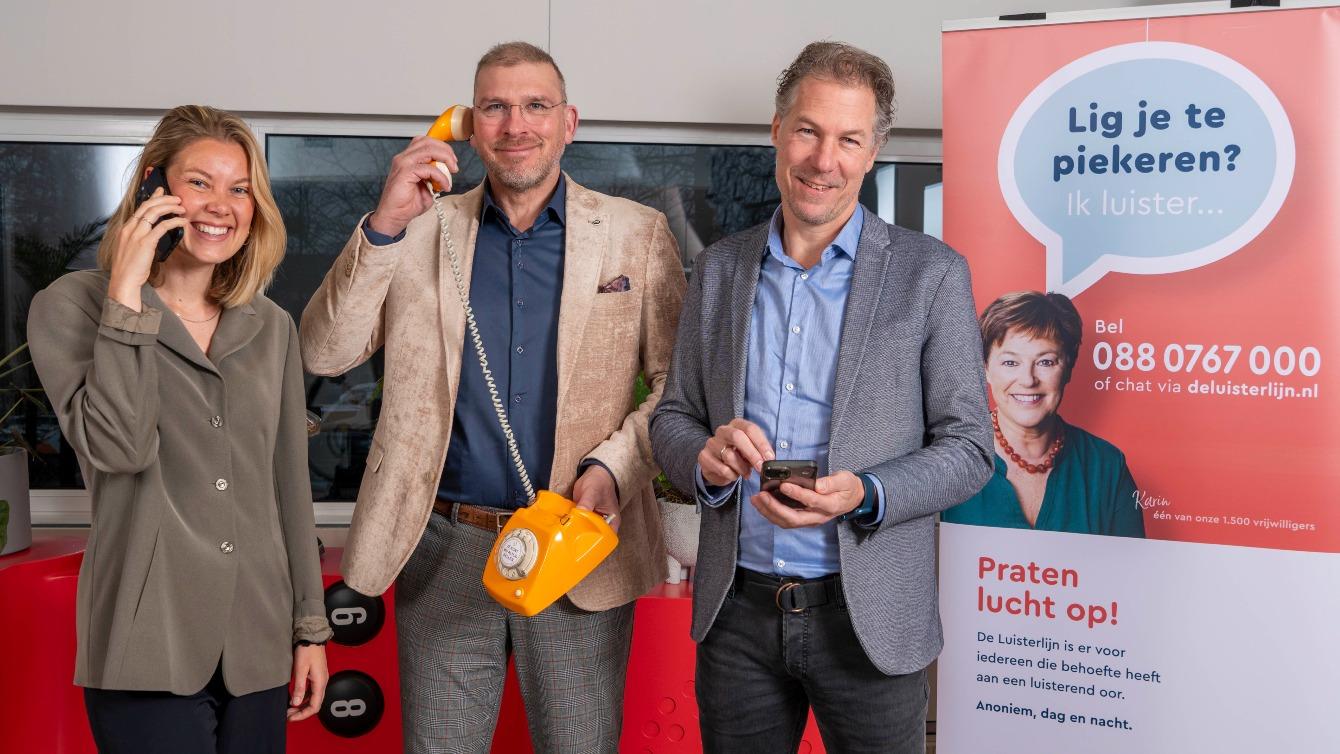
The Luisterlijn has existed under various names since 1958. Its founder was Rotterdam clergyman Teutscher. Today, the organisation boasts nearly 1,500 trained volunteers who, annually, conduct over 300,000 conversations via phone, chat, and email with individuals in vulnerable situations. These interactions are anonymous and can occur during day and night, 24/7. Recurring topics of conversation include loneliness, mental and physical health, relationships, meaning in daily activities, divorce, and financial difficulties. A few years ago, scientists concluded that the Luisterlijn fills a clear societal gap at relatively low cost. It significantly contributes to the physical and mental health of both participants and volunteers and has the potential to play a larger societal role, researchers pointed out. Thew organisation’s new CEO, Richard Coonen, intends to deliver on that promise. 'Listening is in our DNA,' says Richard. 'To do so more effectively, we’re ready to step forward and connect with the world around us in new ways.'
The added value of collaboration
In 2024, the Luisterlijn collaborated with a multidisciplinary PwC team led by Berry Driessen, partner innovation & experience consulting at the PwC Experience Centre. Berry explains, 'At PwC, our purpose is to contribute to trust in society and to help solve important societal issues. Loneliness is one such issue, and the Luisterlijn offers a solution. A listening ear can reduce feelings of loneliness. An organisation like this deserves more attention and support from society.' Richard adds, 'In the coming period, we want to reach more people, recruit more volunteers, and innovate. That requires greater brand awareness, because there are still too many people out there who don’t know about the Luisterlijn. In working with PwC, we were quick to agree that generating additional income through donations can help us realise these ambitions. We receive annual subsidies from the Dutch government, but to invest in innovation, research, and further brand awareness, we need to expand our funding streams.'
Berry emphasises, 'A key element in our work with Richard and his team is that we applied design thinking. That means we first worked to understand the problem through research, then creatively identified new opportunities, and finally narrowed down and implemented just a couple of specific, high-potential solutions—all based on the direct needs of the target audience. This approach keeps you from wasting time on ungrounded efforts to develop the organisation.'
Researching promising solutions
One of the PwC team members, Juliette Brands, elaborates on the subsequent process: 'As a community of solvers, we developed target audience profiles and analysed the feasibility and potential impact of various forms of donation: we didn’t just look at financial donations, but also at contributions of time, expertise, resources, and office space. We also explored opportunities for the Luisterlijn to generate additional income independently, such as by extending its offer of expertise in listening skills—an option with future potential. We collaborated with our Tax department to clarify the legal framework within which the Luisterlijn, as a Public Benefit Organisation – an ANBI, in Dutch – can attract third-party funding. This included exploring tax benefits for donors.'
A new digital donation platform
In the end, the Luisterlijn and the PwC team decided to further develop two approaches: solidifying the basis for donations—this included building a modern digital donation and crowdfunding platform on the website—and creating a collaboration proposition for third-party organisations. Juliette explains, 'The proposition highlights the added value of partnering with the Luisterlijn for organisations. It shows how contributing can enhance their social footprint or enrich their employees with a workshop on listening skills, for instance. It presents the Luisterlijn as an appealing partner for collaboration.'
Both Juliette and Berry were moved by the Luisterlijn’s meaningful work. Berry shares, 'For a project like this, I don’t mind getting up even earlier than I normally do, because loneliness is something I see all around me—in family members, among the elderly, or on the street. It also resonates with me as a professional: through projects like this, we can use PwC’s core expertise to create value for society. To me, that’s the sweet spot of social sustainability.' Juliette adds, 'Throughout our collaboration with the Luisterlijn, I often found myself proudly telling friends about the Luisterlijn’s work and how we were contributing. It also changed my perspective on society—making me more aware that loneliness is everywhere, even close to me.'
Ready for the future
Following up on its collaboration with PwC, the Luisterlijn is now actively seeking new partners, including other social organisations and businesses. Richard concludes, 'We are working on a strategic plan focused on increasing our brand awareness and recruiting more volunteers. We are looking for well-known Dutch figures who can promote our mission as ambassadors. Innovation is on the agenda, too, including improving scheduling, conversation registration, and training methods. To foster social cohesion, we plan to launch a social intranet as a meeting place. I’m extremely enthusiastic about our future opportunities. Loneliness is widespread in our society. Almost half of all Dutch people experience it at times, and I know it from my own youth. Now, here I am with our fantastic team. We are bursting with ambition. With the kind of solutions PwC helped us develop, we are more ready than ever for the future.'
Interested in discussing your organisation’s societal impact or social sustainability positioning?
Contact us


