










CFRO Menno Harkema about his role at insurer Lifetri
After holding various financial positions in his career, Menno Harkema joined insurer Lifetri as chief financial and risk officer (CFRO) two years ago. Together with PwC partner Jan Driessen, he talks about the importance of having a good balance between one’s work and personal life, how he fulfils his role as CFRO at Lifetri, and the difference between working for a large company and a small one. ‘In my experience, a small and focused company is more challenging than a large company. There is not as much politics and there is more pressure. That is why you can perform better.’
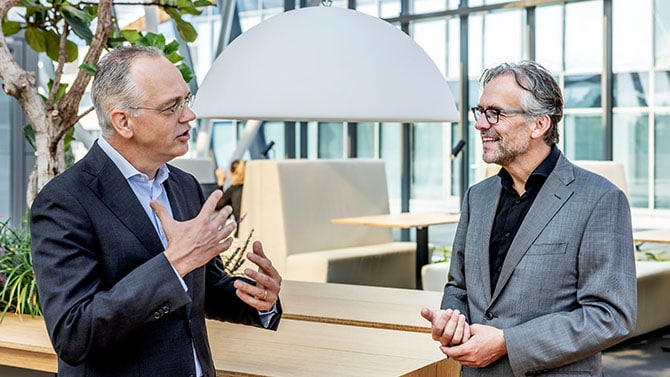
Jan Driessen en Menno Harkema
‘Working actually gives me more energy’
Around two or three times a week, Menno Harkema starts his busy working day by going jogging early in the morning. ‘This means I am fresh when I start my day, and this helps me to get new ideas’, explains the CFRO, who believes his job does not drain his energy. ‘On the contrary, working for Lifetri actually gives me more energy. Work does not tire me; I actually enjoy it. However, I make time to relax at the weekends. I like reading, meeting friends for a meal, and going to the theatre. I have few problems ensuring a good balance between my work and personal life.’
‘For instance, I travelled from Cape Town to Amsterdam in a Land Rover in just under a year’, adds Harkema. ‘It is good to occasionally create precious memories and take a break from things. The best way to create an effective work-life balance is to examine how you split up your work. Everyone is good at fire-fighting, but it is better to take preventive measures, so that individual ‘fires’ do not end up on your to-do list.
A lot of my work is like doing a puzzle. It can be tiring, but I also enjoy Sudoku because I like dealing with numbers. I have great difficulty imagining what it would be like to stop working. Naturally, you should not allow work to occupy your whole life; that is why I try to read a little in the evening.’
Proud of cooperation Allianz pension schemes
Jan Driessen: ‘What motivated you to join Lifetri two years ago?’
Harkema: ‘Because of my past experience at Axent, I knew that working for a small, focussed company was more enjoyable than a large company. There is not as much politics. In addition, working for a private equity shareholder makes you push yourself to the limit. There is more pressure, which means you perform better.’ In addition, we try to grow, while many life insurance companies are trying to downsize and limit their costs. When I started here, Allianz assigned its pension schemes to Lifetri. The fact that the largest insurer in the world wanted to work with us gave me confidence, and can be used as a marketing tool for the rest of the world. I mean, who could doubt us?’
Driessen: ‘You sometimes have to take risks in order make payouts. The same applies to pensions. Lifetri is involved with private equity. What is your take on the matter?’
Harkema: ‘Private equity comes with a negative connotation. But you have to realise that our investors are pension funds. It feels like a revolving eco-system. They are more economical and responsible with capital. Partly due to the new pension agreement, many people want certainty. This is only possible if there is more capital in the market. But this is not always the case, so it must also come from private equity.’
‘See bureaucracy as a foothold and let it work for you’
Harkema earned his spurs at companies like Fortis and ABN AMRO, two major financial institutions. However, he has no need to work for a large organisation. Harkema: ‘I had many positive experiences because there are so many different in-house specialists. I understand that young people want to work for large organisations. This can be good for their personal development.’

Jan Driessen
Driessen: ‘Slowly but surely, Lifetri has also attracted a lot of talented individuals. How did you manage that?’
Harkema: ‘Different interests must be considered in large organisations. And the overall picture is too big to envisage. There are various departments, which do not always focus on customers. Small organisations primarily focus on the interests of customers. Bureaucracy helps in this case. Regulatory bodies and legislation help you to incorporate a certain degree of bureaucracy into your organisation. I compare it to road markings; you know which lines you cannot cross. At the same time, they are not guardrails that forcefully keep you on the road. It thus gives you stability. So let bureaucracy work in your favour.’
‘CRO function cannot have a veto’
When it comes to retaining personnel, Harkema says that Lifetri is doing well. ‘As a small organisation, you must employ people with a broad skills set. Sometimes, this means you are employing people who are over-qualified for the work they are carrying out. So you must clearly communicate this when they are recruited, so there can be no misunderstandings on this front. And that also applies to us as directors. You sometimes have to roll up your sleeves more often here, but I really enjoy that.'
As CFRO, Menno sees an overlap between the position of CRO and CFO, but also sees an issue. ‘Directors have a common responsibility. I don’t think people in CRO positions can exercise a veto; you always have to do this in consultation with other directors. They must always weigh up the positives and negatives. As CFRO, I really enjoy being able to combine things. Good CFRO's must be willing to play devil's advocate if necessary. And accept that they will occasionally be unpopular. On the other hand, you must also positively surprise your colleagues.’
Be alert for cybercrime
Looking at the (near) future, Harkema is personally concerned by a number of developments. ‘Just like the rest of the world, I am very concerned about what is happening in Ukraine. And it is clear that something has to be done about the climate. I realise that meat and dairy production has a negative impact on the climate crisis. Personally, I want to do something about this by buying less dairy, meat and fish.’
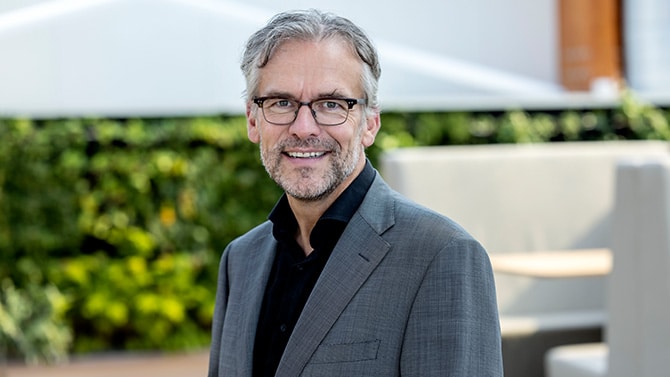
Menno Harkema
Harkema is excited about the latest technological developments, although he is also aware of the risks. ‘We employ economists and actuaries who use their intelligence to do smart things, whereas they previously did a lot of labour-intensive things. In addition, people were able to work surprisingly well from home during the COVID-19 pandemic, even though they did not always enjoy it. But we were able to keep things running because we could continue working in our systems. I believe that cybercrime is an emerging risk, and expect the matter to get even more attention in the future. It is frightening that hacking and holding companies and institutions hostage is almost becoming an industry in itself.’
Driessen: ‘And how do you see your personal future?’
Harkema: ‘I would like to do more when it comes to socially relevant issues. I am open to being part of the supervisory board at a non-governmental organisation, as long as it’s a serious position. This will allow me to pass on my experience in financial and risk management to an organisation that is dedicated to creating a better and fairer world.’

Contact us

Follow us


